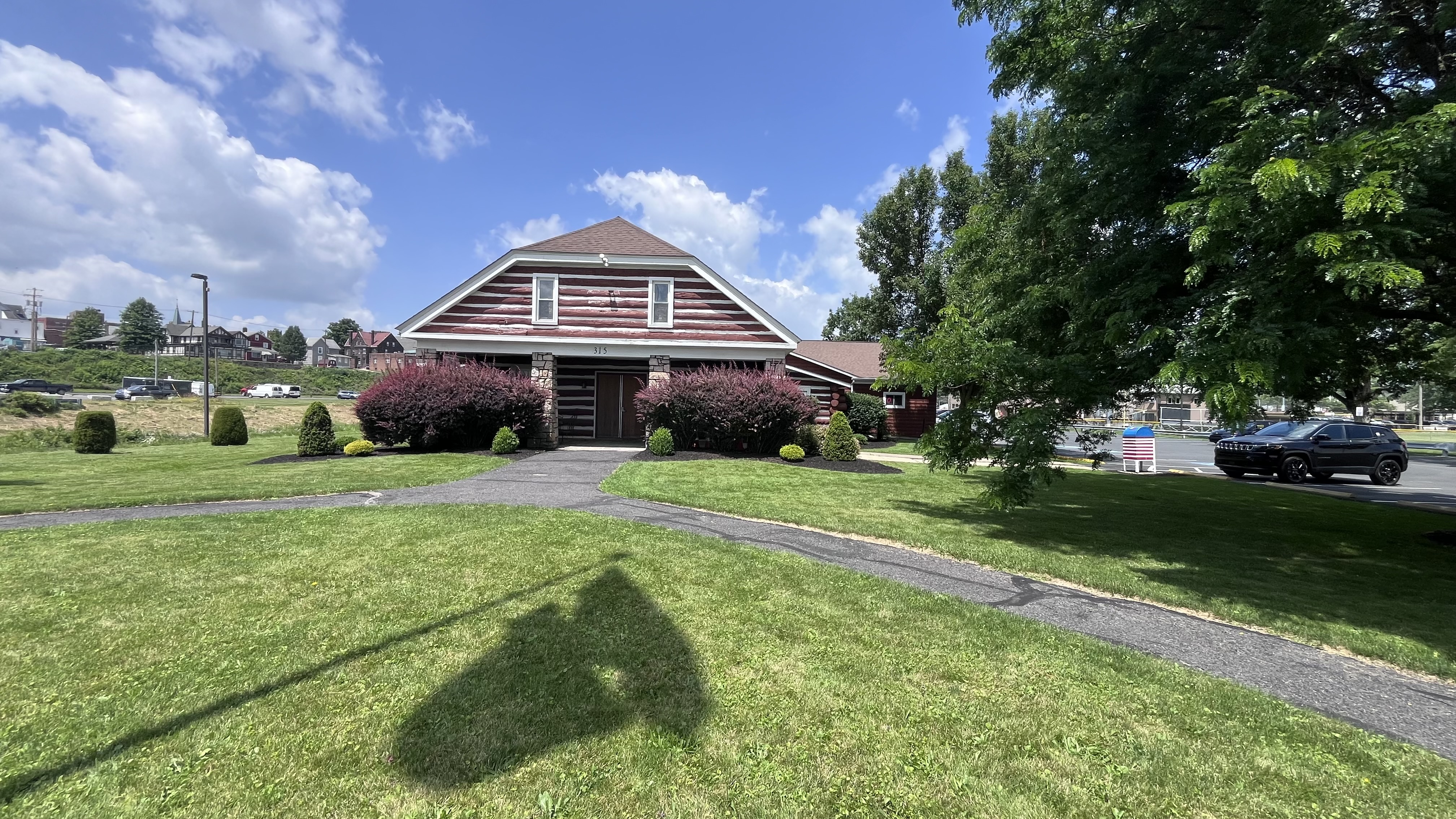
Montgomery Post 17 stands as a monument to the men who served in the Great War/World War I. The American Legion was established in France following meetings in 1919. It is intended to provide a smooth transition to servicemen entering civilian life.
Returning DuBois soldier James Frey called for those returning home from the war to meet at The Courier-Express building. Enough interest was generated to suggest that a charter be sought. Organizational meetings were held on the second floor of the DuBois National Bank building.
On June 8, 1919, twenty DuBois men signed their names to the request for the charter. More men joined the initial group, and meetings had to be moved to the Acorn rooms.
The charter was granted on June 14, 1919, with 50 veterans becoming charter members of one of the earliest established posts in Pennsylvania.
John Jacob Pentz was elected the post’s first commander. Shortly after the formation the name Montgomery Post was selected to honor George Dwight Montgomery, the first DuBois officer killed in action, October 8, 1918.
More men joined, and the increasing numbers forced a move to the Hatten building over Con Allen’s Shoe Store. Within 10 years, discussions were underway to find Post 17 a home of its own. On October 30, 1930, City of DuBois officials approved the Legion’s plans and granted a piece of land, then occupied by Oliver T. Korb, to the Post on a 99-year lease. In July 1970, the land was then purchased by George D. Montgomery American Legion Post.
Ground was broken for the new Legion home on June 1, 1931. John E. DuBois donated the dance pavilion in the Driving Park and it was dismantled and its lumber reused to build the post. The hemlock logs, some 12 to 15 inches thick, were stained with creosote and whitehair plaster was used to fill in the chinks. The port pillars are native sandstone. The original sidewalk was laid of flagstone.
This building, costing $10,500, was completed in four months with volunteers from the Legion doing most of the work. The first meeting in the new building was held on October 8. The formal dedication was on Armistice Day, November 11, 1931. A fall festival was held from November 12-19 to celebrate the new home.
Several additional rooms were added at the rear of the building in 1946 to house the facilities of the new Army & Navy Service Club. The work was completed in November.
In 1929, DuBois’ Montgomery Post 17 of the American Legion took action on the need for an airport, moving it from a location in the Beaver Meadow. A new area, the Lowe farm, was selected in Sandy Township (the present site of Spider Lake). A township road bisected the site and could not be abandoned until a new one was built. The city was without authority to re-locate the road; the township had no money with which to do it. It seemed possible that the government would abandon DuBois as a stopping point.
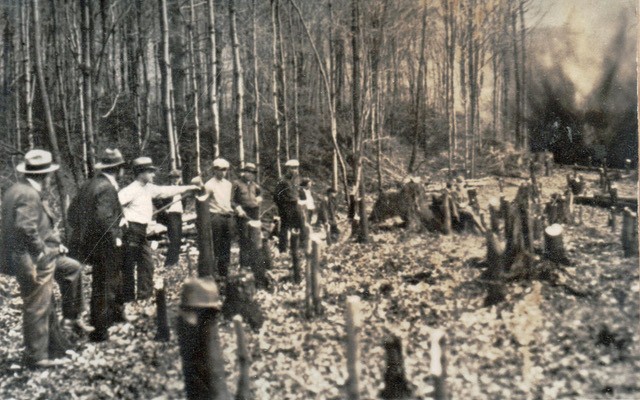
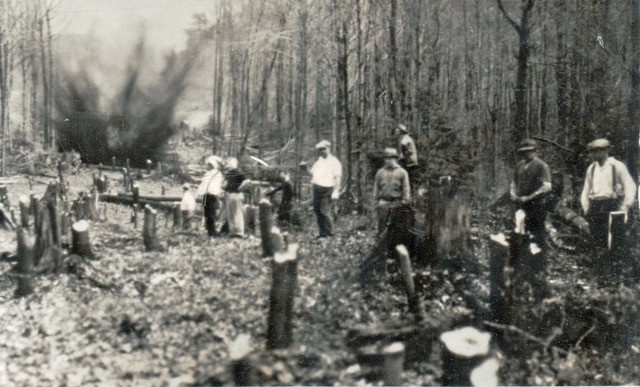
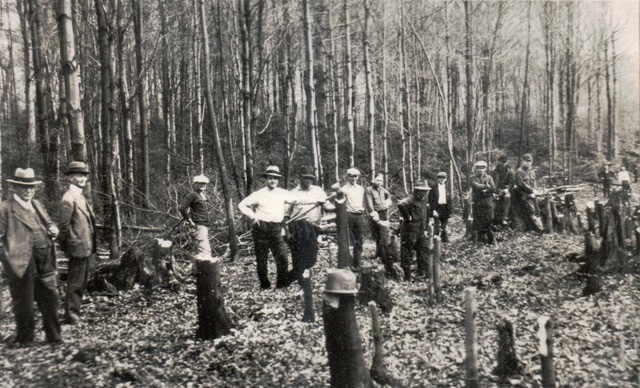
Montgomery Post had been talking about establishing an airport. It volunteered to build the new road — obtain all the money necessary and handle all other details. It wasn't an easy job. The new road had to be built according to fixed engineering standards – 16 feet wide, with sub-drains and grading, and a 12-inch covering of cinders. For almost a half mile, the new road would run through a second-growth forest — trees that had grown sturdily for twenty years.
The Post first appealed for funds from businessmen. Contributions were given gladly. Volunteer labor was requested to supplement the work of the members. A Post member, who was also the assistant city engineer, made the survey for the road, estimated the material needed, and bossed the job generally. On the first workday, 60 or 70 men turned out. They started at 8 a.m. and by 9 p.m. felled all the trees on the path marked out. The fallen timber was dragged out and stumps blown up using donated dynamite, fuses, and caps. Two Legionnaires who had been miners and another who had served with the engineers during World War I directed this work.
All Post members were urged to take part in the work. Those who couldn't come out personally sent substitutes or paid a day’s wages for a hired worker. Citizens paid for teams that were hired. Food was donated to supplement them. The members of the Legion Auxiliary unit sent their husbands hot coffee, cake, and other good things. The Pennsylvania Railroad helped by providing the cinder supply, thanks to Legionnaire W. W. Atterbury, president of the railroad.
DuBois’ first airport was dedicated on July 18, 1929, as DuBois Legion Airfield. The hangers housed privately owned airplanes, training flight airplanes, and stunt flying and parachute jump airplanes.
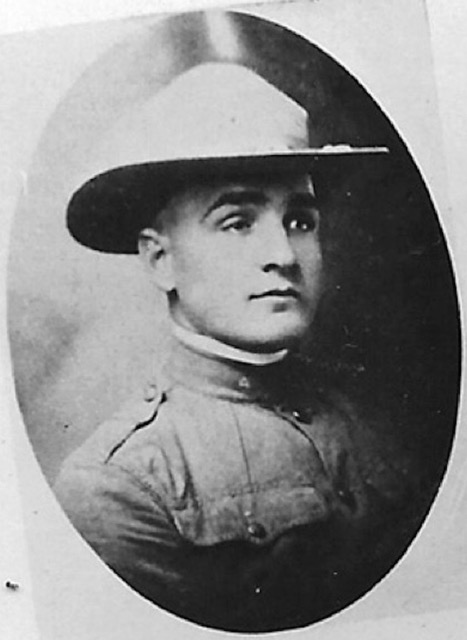
George D. Montgomery was born in Sligo, Pennsylvania, on Feb. 20, 1895. His family later moved to DuBois, and he graduated from DuBois High School, where he was captain of the football team.
Along with many of his classmates, he was concerned with the situation in Europe. Shortly before that class graduated in May, a German U-boat sank the British luxury steamship Lusitania. 1,128 died, including 128 Americans. President Woodrow Wilson was elected with the promise to keep the U.S. out of the war, but that didn’t seem possible any longer.
Montgomery was working as a laundry wagon driver when he joined the U.S. Army National Guard at Ridgway on June 20, 1916. He quickly moved up the ranks, being promoted to corporal on July 2, 1917, and to sergeant on September 1. He completed officer’s candidate school and was honorably discharged from the school on September 30, 1918, several months after Montgomery and his companions had left for France. His unit was in the thick of the fighting as the U.S. entry into the war broke the stalemate on the Western Front, turning the tide in favor of the Allies.
Montgomery was commissioned as a second lieutenant on October 1, 1918. He only got to enjoy the promotion for four days until he was shot and killed by a German sniper during the Meuse-Argonne offensive. He was the first officer from DuBois to die in World War I. Forty men and women from DuBois died in World War I.
He was originally buried in France. His remains were moved to Wattersonville Cemetery in Armstrong County in 1921. When the DuBois American Legion was formed in 1919, it chose to name it the George D. Montgomery Post 17 in honor of the fallen officer.
In 2005, then Post 17 Vice Commander Paul Sprague, while investigating Montgomery’s background, discovered that the gravestone needed to be replaced. Post 17 backed a replacement project, and the new stone was dedicated on September 9, 2005.